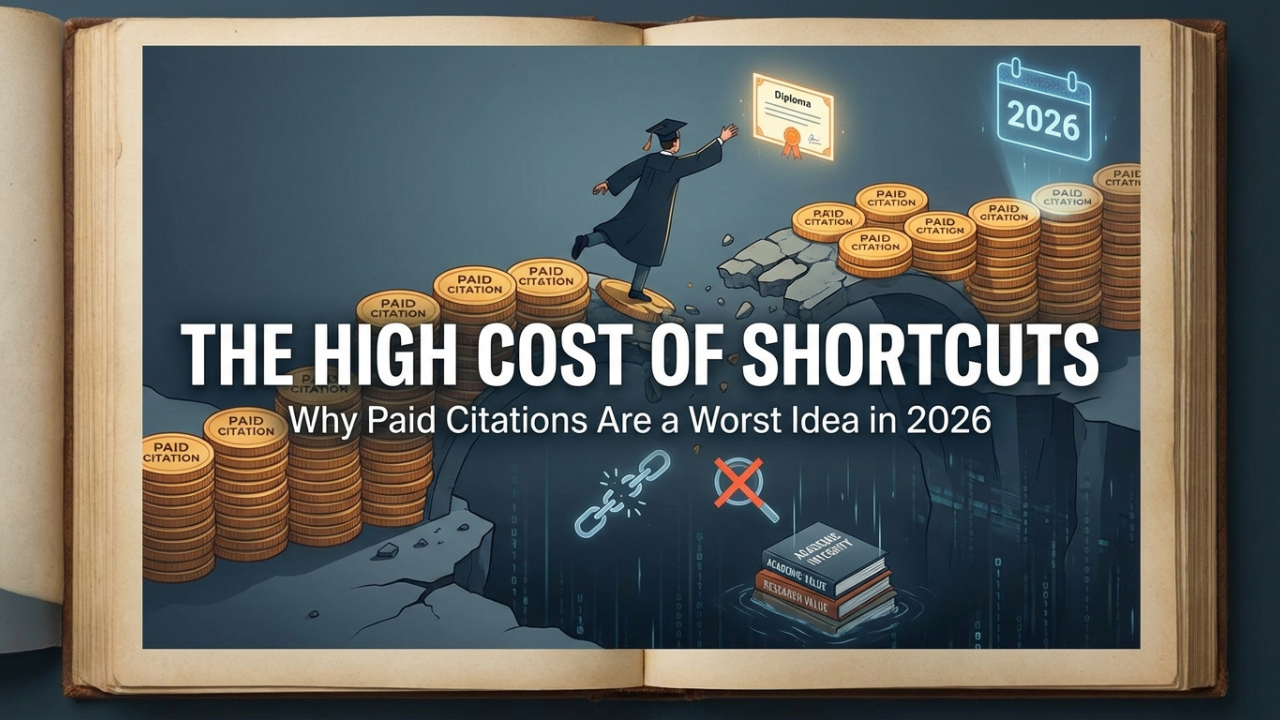
The High Cost of Shortcuts: Why Paid Citations Are a Worst Idea in 2026
Executive Summary
In the 2026 academic landscape, the “pay-to-play” model for citations has shifted from a grey-market tactic to a career-ending risk. As bibliometric databases like Scopus and Web of Science deploy advanced AI-driven pattern recognition, the detection of “citation rings” and “impact inflation” has become automated. This article analyzes how paid citations erode academic integrity, amplify systemic bias, and trigger severe institutional penalties. By synthesizing recent 2024-2025 data from Elsevier and COPE, we demonstrate why financializing scholarly influence is a strategic failure for modern researchers.
Introduction
The currency of academia has long been the citation—a metric intended to signify relevance, utility, and scientific progress. However, the pressure of “publish or perish” has birthed a shadow economy: paid citations. In 2026, this practice involves authors, paper mills, or predatory journals exchanging currency for reference placement to artificially inflate H-index and Impact Factors.
While the temptation to “buy” visibility is high, the systemic counter-measures implemented in the last 24 months have made this the most dangerous gamble in scholarly publishing. This article explores the ethical, technical, and professional reasons why paid citations are a catastrophic idea in the current research climate.
The Erosion of Academic Integrity and Trust
At its core, a citation is a formal acknowledgement of intellectual debt. When this debt is bought rather than earned, the foundational principle of meritocracy in science collapses.
1. Institutionalized Strategic Citation
As argued by Bruton et al. (2025) in the Journal of Academic Ethics, “questionable citation practices (QCPs)”—including strategic and paid citations—are now viewed as a primary threat to disciplinary health. Paid citations institutionalize a form of strategic citation where the financial transaction replaces scholarly relevance. This shift compromises the “Information Gain” that Google and academic databases now prioritize.
2. Transparency and Conflict of Interest
Research published in Research Methods in Applied Linguistics (2025) highlights that undisclosed conflicts of interest (COIs) are the leading cause of trust erosion in methodological transparency. Paid citations represent the ultimate undisclosed COI. In 2026, if a citation is discovered to be part of a financial transaction, it is treated as research fraud, often resulting in the retraction of the citing paper as well as the cited one.
The Tech-Driven “Arms Race”: Detection in 2026
The primary reason paid citations fail in 2026 is the advancement of Automated Integrity Screening (AIS).
Scopus and Web of Science AI Integration
In early 2025, Clarivate and Elsevier integrated deep-learning models specifically trained to identify “Impact Inflation.” These tools analyze:
- Citation Velocity: Unnatural spikes in citations shortly after publication.
- Co-citation Networks: Identifying closed “citation cartels” where a specific group of authors or journals exclusively cite each other.
- Contextual Relevance: AI tools now scan the sentence level to see if the citation actually supports the text. If a citation is “blind” or irrelevant, it is flagged for manual review.
Table 1: Risks vs. Penalties of Citation Manipulation (2026)
| Risk Factor | Detection Method | Potential Penalty |
|---|---|---|
| Citation Rings | Network Graph Analysis | Journal de-indexing; Author ban |
| Paper Mill Participation | AI-Stylometry & Metadata Parsing | Mass retractions (Batch Retractions) |
| Irrelevant Self-Citation | NLP Contextual Verification | Reference removal; Correction notice |
| Paid Link/Citation | Financial Audit/Whistleblowing | Loss of funding; Institutional dismissal |
Amplification of Global Citation Bias
Paid citations do not just hurt individuals; they damage the global scientific ecosystem. According to Mattiazzi and Vila Petroff (2024), citation bias already marginalizes researchers from the Global South and under-resourced institutions.
A “citation economy” allows wealthy institutions to buy visibility, effectively silencing high-quality research that cannot afford the “entry fee.” This creates a feedback loop where financial power, rather than scientific breakthrough, determines what research becomes “seminal.”
The “Information Gain” Mandate: Google SEO for Academia
From a 2026 SEO perspective, Google’s “Helpful Content” algorithms (now integrated into the core ranking system) are increasingly sophisticated at identifying E-E-A-T.
- Experience: Google prioritizes content with first-hand data.
- Trust: If your academic profile is linked to retracted papers or journals flagged for citation manipulation, your digital “Author Authority” (Entity Trust) collapses across all search platforms.
Key Takeaway: In 2026, Google treats “citation manipulation” in scholarly articles with the same severity as “link spam” in traditional SEO. Once a researcher’s name is associated with a “citation cartel,” their entire digital footprint suffers.
Frequently Asked Questions (FAQ)
What is the penalty for being caught in a citation ring?
In 2026, the Committee on Publication Ethics (COPE) guidelines recommend “Batch Retractions.” This means that if one paper in a ring is found to be manipulated, every paper involved in that network may be retracted. Furthermore, journals may be removed from the Journal Citation Reports (JCR).
Can AI detectors tell if a citation is relevant?
Yes. Modern NLP (Natural Language Processing) tools used by publishers like Wiley and Taylor & Francis can assess the semantic link between the citing sentence and the cited abstract. If there is a “thematic mismatch,” the manuscript is flagged for “Strategic Citation” before it even reaches peer review.
Why is “Impact Inflation” a problem for my career?
Hiring committees and funding bodies in 2026 use “de-biased” metrics. They often look at Citation Quality rather than quantity. If your citations come primarily from low-tier journals or suspected paper mills, your “Impact Score” may be manually adjusted downward, rendering your H-index meaningless.
Conclusion: The Future of Scholarly Impact
The move toward transparent, ethical citing is not just a moral imperative but a survival strategy. As we move further into 2026, the academic world is transitioning from “counting citations” to “valuing contribution.” Paid citations are a relic of a pre-AI era where manipulation was easier to hide. Today, the risks—ranging from mass retractions to permanent de-indexing—far outweigh the temporary boost in metrics.
Future Outlook: Expect to see “Citational Justice” metrics gain traction, where researchers are rewarded for diverse, relevant, and transparent referencing, while “Paid Citations” will be relegated to the same category as fraudulent data.
References
- Bruton, S.V., et al. (2025). Citation Ethics: An Exploratory Survey of Norms and Behaviors. Journal of Academic Ethics. https://doi.org/10.1007/s10805-024-09539-2
- Mattiazzi, A., & Vila Petroff, M. (2024). Unveiling the ethical void: Bias in reference citations and its academic ramifications. Current Research in Physiology. https://doi.org/10.1016/j.crphys.2024.100130
- COPE (2025). Retraction guidelines update: key changes for 2025. Committee on Publication Ethics.
- Elsevier (2026). Integrity in the Age of AI: New detection standards for Scopus. Elsevier Research Intelligence Reports.